
Earn yield on ETH with one token: how Everstrat works
 smeshny4 min read
Updated
Main takeaways
- Deposit ETH to mint EVE, one token that represents a share of the whole strategy portfolio.
- Strategies plug into a shared core, so they can be added or replaced without holders moving their funds.
- Everything is measured in ETH, so the question EVE answers is simple: did this beat holding ETH?

On this page
Earning yield in DeFi usually means doing a lot of work yourself. You pick a vault or a pool, deposit into it, take on that curator's or protocol's trust assumptions, and then repeat the process for every position you want. Rebalancing, monitoring ranges, and moving capital between opportunities are all on you.
Everstrat bundles that work into one position. You deposit ETH once and receive EVE, a token that represents your share of a portfolio of automated on-chain strategies.
Mint, hold, redeem
Using Everstrat comes down to three steps:
- Mint. Deposit ETH through Everstrat's native market and receive EVE. The app shows you a quote, including the amount of EVE you will receive and your slippage limit, before you sign.
- Hold. EVE's value tracks the net value of the portfolio behind it. As the strategies earn, the amount of ETH backing each EVE token can grow.
- Redeem. Return EVE to get ETH back. If enough ETH is available, this happens in one transaction; otherwise your request joins a redemption queue and is processed in a batch.
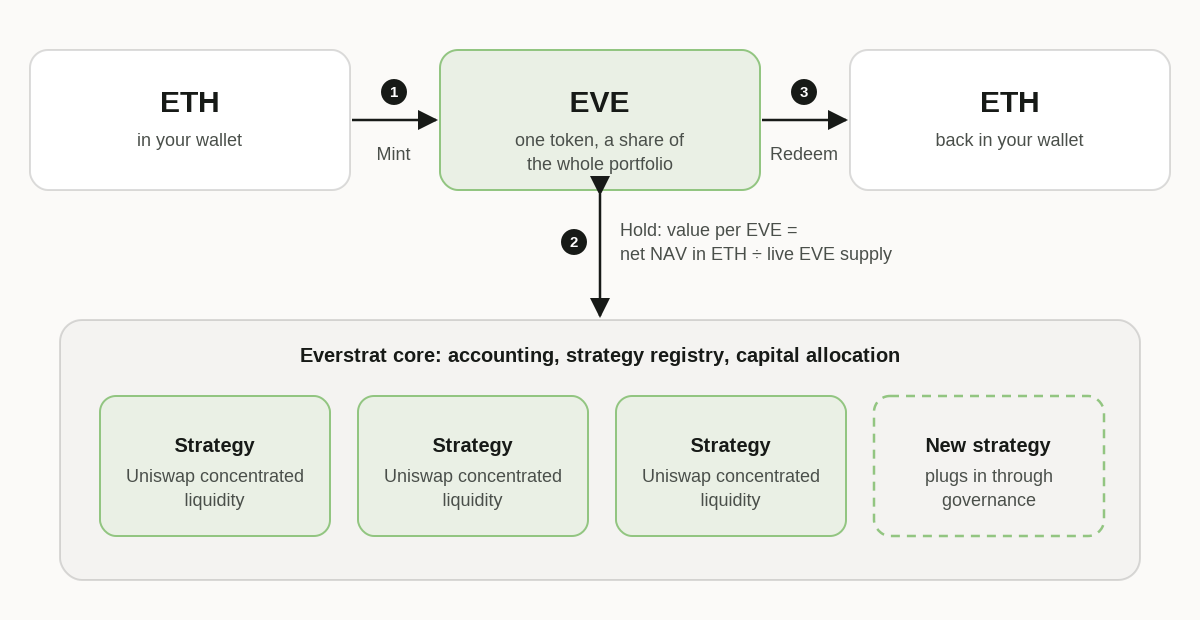
The price you pay or receive comes from the protocol's pricing rules rather than a fixed exchange rate. Understanding EVE and NAV explains how that price is calculated, and how redemptions work walks through the exit path step by step.
A shared core with swappable strategies
Everstrat is built like a building with a permanent core and replaceable modules. The core, a management layer, holds the accounting, keeps track of which strategies are registered, and moves capital between them. Each strategy is a separate module that plugs into that core.
This design has a practical benefit for holders: when governance adds, retires, or reconfigures a strategy, nobody has to withdraw and redeposit. Your EVE stays the same token while the portfolio behind it changes.
Today's strategies provide concentrated liquidity on Uniswap: each one supplies liquidity to a pool and manages the price range of its position so it keeps earning trading fees as the market moves. Its main risk is impermanent loss, where a liquidity position ends up worth less than simply holding the two assets.
Routine work, such as maintaining positions and processing the redemption queue, is handled by keepers: automated services that can only call the operations the contracts already allow. Governance and on-chain limits covers who controls what.
Why everything is measured in ETH
Everstrat uses ETH as its unit of account from start to finish. You deposit ETH, the portfolio's value is reported in ETH, EVE's price is quoted in ETH, and redemptions pay out ETH.
That makes the benchmark explicit. Holding ETH earns nothing by itself, so the useful question is whether a position has grown in ETH terms. EVE is designed to answer exactly that.
Two details are worth keeping in mind:
- ETH accounting does not mean ETH-only positions. A liquidity position holds ETH and a paired token, and its mix shifts as prices move. Everstrat values that whole position in ETH so it can be compared on one scale.
- ETH returns and dollar returns are different numbers. If ETH's price falls, your position can grow in ETH and still be worth fewer dollars. If ETH's price rises, a higher dollar value does not by itself mean the strategies outperformed.
Before you deposit
Everstrat is new, experimental software that has not been audited yet, and it handles real ETH. Access is currently invite-only. Strategy returns are not guaranteed, liquidity positions can lose value, and redemptions may need to wait for the queue. Reading how the system works is the best way to know what you are holding.
The protocol introduction, architecture overview, and risk disclosure are the authoritative references.