
Redeeming EVE for ETH: how the redemption queue works
 smeshny3 min read
Updated
Main takeaways
- If enough free ETH is available, a redemption settles in a single transaction.
- Otherwise, your EVE waits in a queue and is processed in a batch, so strategies do not have to unwind for each exit.
- Processed ETH is credited to you and withdrawn with a separate claim; canceling returns your EVE.

On this page
Most of the ETH in Everstrat is working inside strategies, not sitting idle. Redemptions are designed around that fact: small exits can be paid straight away, and larger ones are grouped so the portfolio can free up ETH in an orderly way.
Instant redemptions
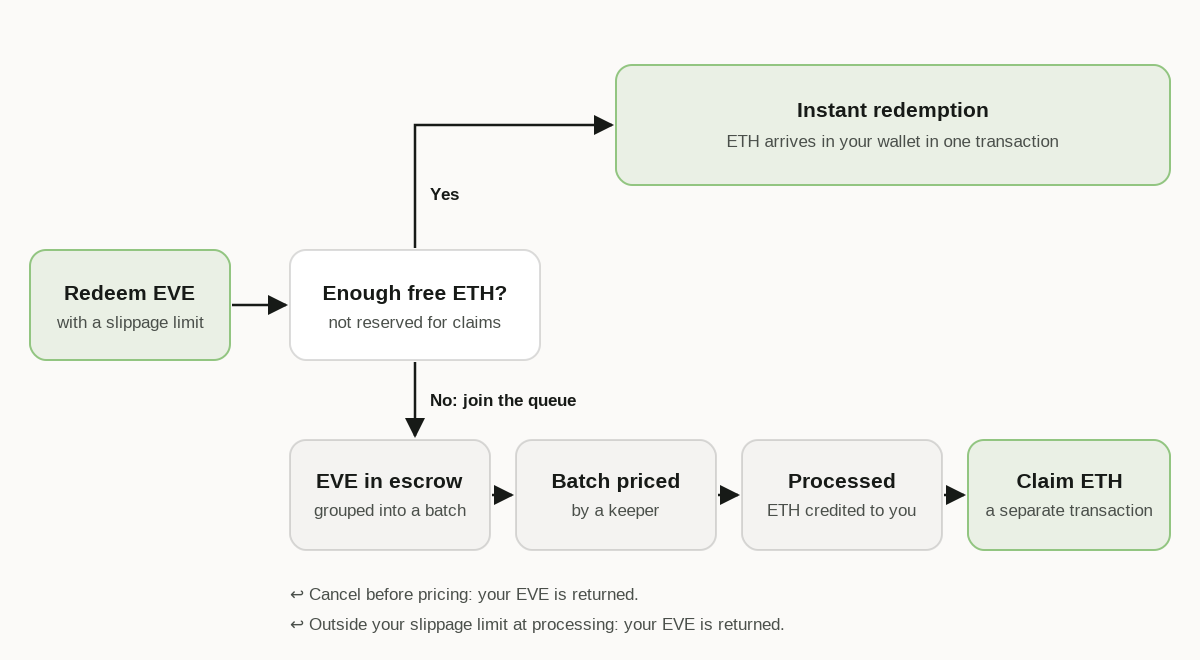
Everstrat's native market keeps track of how much of its ETH is free, meaning not already reserved for someone else's claim. When you redeem and there is enough free ETH, and the pricing and safety checks pass, the exit settles in one transaction and ETH arrives in your wallet.
The redemption queue
When there is not enough free ETH, your request joins the redemption queue instead. Here is what happens next:
- Your EVE goes into escrow. The market holds it until the request is resolved.
- Requests are grouped into a batch. Batching lets the strategies release ETH for many exits at once instead of unwinding positions for every single request.
- The batch is priced. A keeper, an automated service, triggers pricing, which fixes the settlement reference for that batch.
- The batch is processed. Each request is checked against the slippage limit you set. If it is within the limit, the ETH you are owed is credited to you. If it is outside, the request closes and your EVE is returned, so you never receive a worse price than you agreed to.
Claiming your ETH
Processing credits ETH to a claimable balance; it does not send it to your wallet automatically. You collect it with a short claim transaction whenever you like.
There is a good reason for the extra step: if one wallet in a batch cannot receive a transfer, it would otherwise block everyone else. Separating claims keeps the batch moving for all holders.
Changing your mind
Before a batch is priced, you can cancel your request and get your EVE back. Once pricing happens, cancellation is locked so the batch can settle at the price it was given.
Processing has a three-day window after pricing. If a priced request is still unprocessed after that window has fully passed, cancellation opens again. That is a safety valve, not a timetable: the window starts at pricing rather than at submission, so it does not promise that every exit completes within three days.
Canceling always returns your EVE. It does not pay out ETH or lock in a future price.
Checking where you stand
The app shows each request's current state: waiting for pricing, priced, processed and ready to claim, or canceled. Each state has a different next step, so check it before acting. Reading your position explains each figure on the portfolio screen.
The queue and native market contracts are public: see the exit queue and native market on Etherscan. For the exact rules, read the redemption queue reference, the exiting and redeeming guide, and the current deployment snapshot.